
Clinical Research Support
Clinical research support provided for Cleveland Clinic Abu Dhabi


Owkin transformed siloed, unstructured clinical data into a queryable patient registry.
We aligned with Cleveland Clinic Abu Dhabi (CCAD) on a first proof of concept to demonstrate how K Pro could support clinical practice.
We focused the scope on prostate cancer and built a two phase solution:
- Processing and harmonizing multimodal, multisource data to break siloes and build a unified registry.
- Connecting K Pro and unlocking agentic exploration of the data.
We showed concrete value: identifying patients and exploring their characteristics in seconds, while drastically reducing the time-to-insight with potential applications for tumor board meetings.
An AI scientist for clinicians
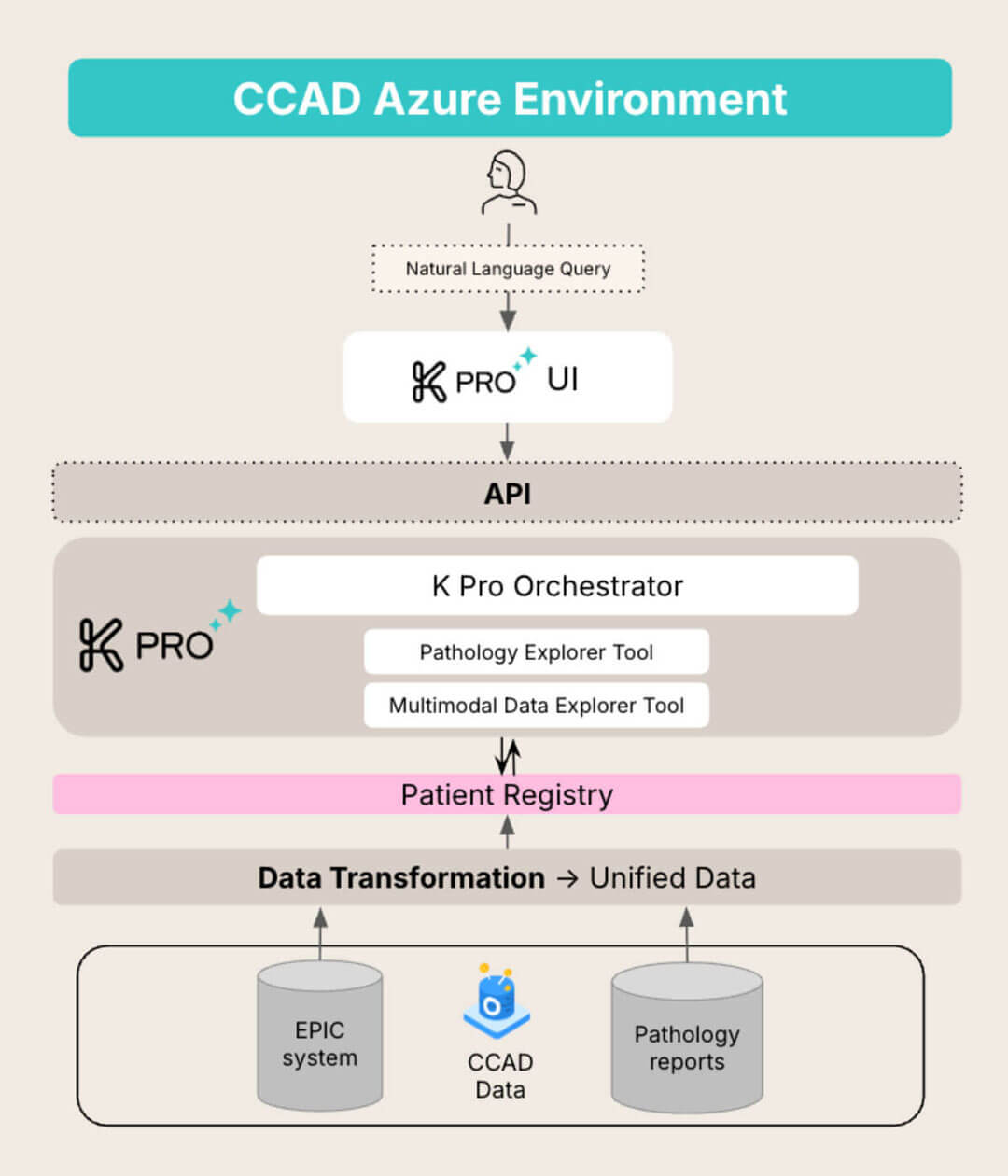
Data Transformation AI integrated CCAD’s electronic health record (EPIC) clinical tables, free-text notes, and 994 pathology PDFs via optical character recognition + LLM extraction into a unified registry of 1,700 prostate cancer patients.
AI-augmented pathology through Owkin's Pathology Explorer Tool analysing digitised H&E prostate cancer slides for cell segmentation and annotation, validated by a CCAD pathologist.
Secure, compliant deployment within CCAD's closed Azure environment using UAE in-region AI models - no data left the hospital, fully compliant with UAE governance rules.
K Pro brought the natural language interface to allow clinicians to query cohort characteristics, treatment patterns, and recurrence outcomes in real time.
We built an AI scientist for clinicians


