
Blog
INVOKE: Closing the Loop Between AI Prediction and Clinical Validation
The INVOKE study is a global, multicenter, Phase 1a/1b, first-in-human, open-label trial evaluating OKN4395 in patients with advanced solid tumors.
Drug development generates enormous amounts of valuable data—but captures only a fraction of its potential. Pharma runs thousands of trials, each producing rich patient information that typically answers narrow regulatory questions: Did this drug work? At what dose? In how many patients?
What gets lost is the deeper biological understanding: why a drug worked in some patients and not others, which pathways were actually modulated, what baseline features predicted response. Companies frequently discover critical biomarkers years after trials end—cetuximab was used in colorectal cancer for five years before KRAS mutation status was recognized as essential for patient selection—making it too late to optimize the original trial design or avoid treating patients unlikely to respond.
This pattern is fixable, but it requires fundamentally closing the loop between AI-driven discovery and clinical validation. That's the architecture behind INVOKE.
AI-directed target and patient selection
OKN4395 is a triple inhibitor targeting EP2, EP4, and DP1 receptors across two related immunosuppressive pathways: prostaglandin E2 (PGE2) and prostaglandin D2 (PGD2). Because both pathways use the same cAMP mechanism to suppress T and NK cells, blocking one pathway alone can be bypassed by the other. OKN4395's triple blockade addresses this redundancy.
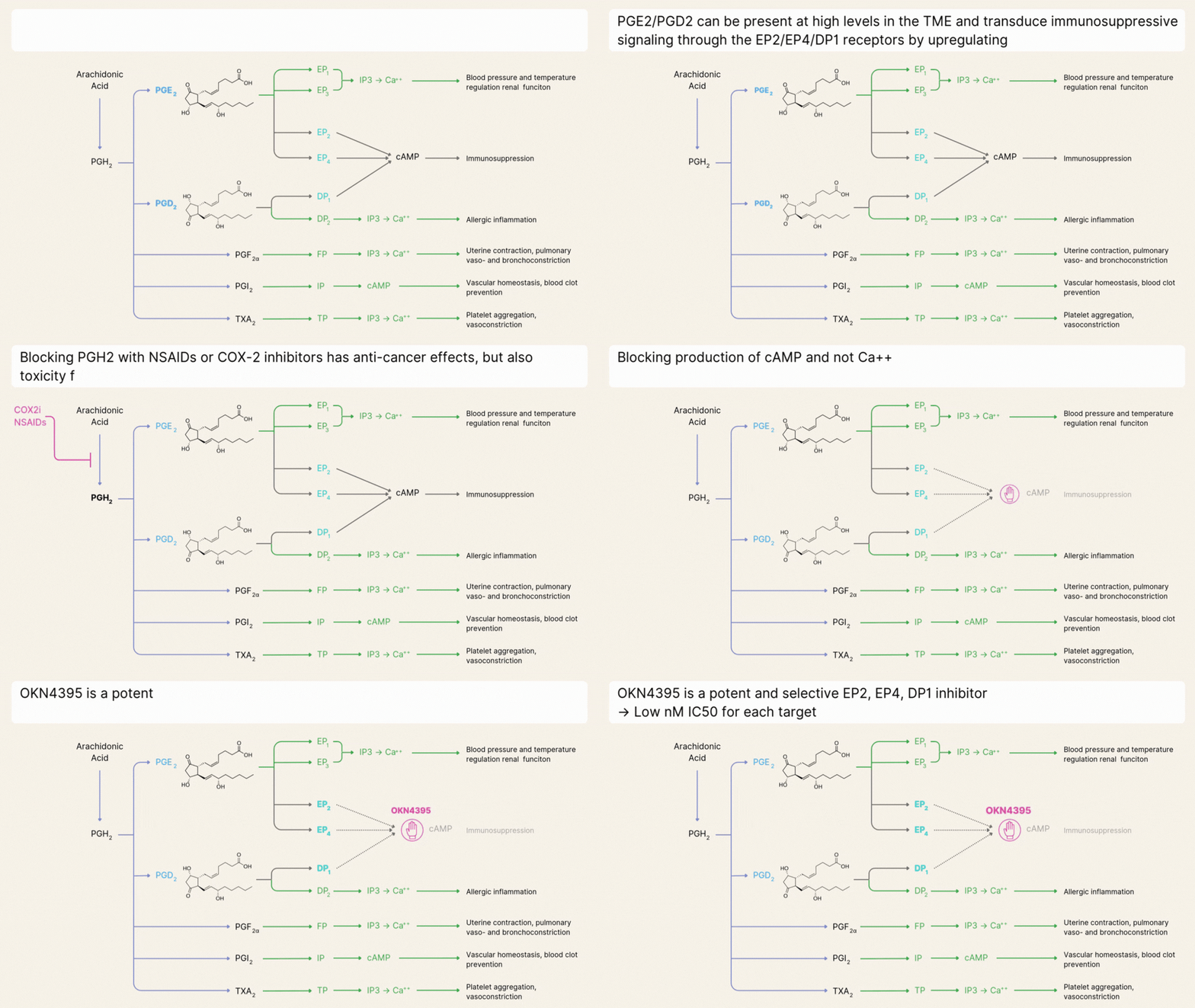
What we needed to understand was the biological significance of this triple inhibition and how to position the drug clinically. K Pro helped us rapidly synthesize existing knowledge about PGE2-PGD2 pathway crosstalk and immune suppression, and generate hypotheses about PGD2's immunosuppressive potency relative to PGE2, the functional consequences of DP1 blockade in human immune cells, and potential synergy with checkpoint inhibitors.
We validated these insights through wet-lab experiments, and the results are detailed in our recent preprint.
Critically, K Pro then predicted which cancer types would most likely respond based on pathway dependence, analyzing multimodal data from TCGA and Owkin's MOSAIC dataset to identify tumors with high PGE2/PGD2 pathway activity. The result: a focused set of five indications selected not by market size but by biological rationale.
Now comes the validation phase: proving the AI's predictions against clinical reality.
Rich data collection from first dose
INVOKE dosed its first patient in January 2025 and is now recruiting across three countries. Like any rigorous Phase 1 trial, INVOKE includes comprehensive pharmacokinetic and pharmacodynamic assessments and target engagement studies. But it goes substantially further: while most Phase 1 trials stop at safety and dose-finding, INVOKE collects rich multimodal biomarker data per patient—clinical outcomes, imaging, digital pathology (H&E and multiplex immunofluorescence), whole exome sequencing, bulk and single-cell RNA sequencing, proteomics, and circulating tumor DNA—designed to systematically validate the AI's predictions about response.
This approach is operationally complex and expensive. The rationale is that INVOKE isn't just testing OKN4395's safety profile, it's testing whether the AI models that predicted OKN4395's mechanism and patient population were correct. Every patient provides ground truth: Did they respond? Did immune cells activate? Did PGE2 levels drop? Did spatial patterns of immune infiltration change in predicted ways?
The AI made specific predictions about biomarker signatures that would correlate with response. The trial design enables systematic validation of those predictions in real time, rather than through retrospective analysis years later.
Real-time learning, not retrospective analysis
Traditional development treats trials sequentially rather than as opportunities for continuous learning. Teams collect data over 18-24 months, lock databases, and analyze according to prespecified plans. Primary results are published a year or more later, but deeper analyses—identifying which patients respond, which biomarkers predict outcomes, which pathways are actually modulated—often don't happen for years, if at all. By then, subsequent trials are already enrolling patients based on incomplete biological understanding. Each trial generates insights that could inform the next, but the insights arrive too late to be actionable.
INVOKE is designed differently. Rather than waiting for trial completion to analyze data retrospectively, the trial feeds information back into K Pro continuously, enabling the platform to evolve in parallel with patient enrollment. This architecture is driving several new capabilities:
- A Clinical Trial Agent that will enable exploration of trial data to identify responder biomarkers, answering questions like "which baseline features predict progression-free survival?" without months of manual analysis.
- Proteomics integration as a new modality in K Pro, enabling supervised biomarker-response analyses on protein data, a capability that didn't exist in the platform before the INVOKE trial.
- External Control Arm methodology using digital twins to contextualize early efficacy signals in single-arm trials, providing comparative context typically unavailable until Phase 2.
- Longitudinal ctDNA tracking to detect molecular response weeks before imaging shows tumor changes, providing earlier decision-making signals.
These capabilities aren't being developed for post-hoc analysis, they're being deployed while the trial runs. As INVOKE moves from dose escalation into expansion, the infrastructure for real-time learning is in place to inform which patients to enroll, which biomarkers to prioritize, and which combination strategies to test.
Learn more about INVOKE and OKN4395
Compounding knowledge across programs
The learning loop has practical implications beyond INVOKE. Early data from the trial is already informing decisions about Phase 1b expansion cohorts: which cancer types to prioritize, what translational biomarkers to assess, whether other combination strategies (beyond anti-PD1) should be tested in parallel.
More broadly, the INVOKE architecture establishes a template for how clinical programs can feed back into K Pro to raise the baseline for subsequent programs. AI identifies targets and patients with increasing precision when continuously validated against real-world data: not just eventual efficacy outcomes, but earlier translational signals like changes in immune cell infiltration on immunohistochemistry, shifts in tumor microenvironment composition, or molecular response markers. Models don't just make predictions; they learn whether those predictions were accurate and refine their understanding iteratively.
Most AI in drug development is unidirectional: build a model, make a prediction, test it, move to the next program. While companies accumulate internal databases, systematic retraining of models with clinical trial outcomes remains rare: each new program largely starts from scratch. INVOKE demonstrates that clinical trials can be designed as learning systems, where each patient contributes not just to a single regulatory submission but to the platform's cumulative intelligence.
Building larger models and analyzing retrospective datasets like MOSAIC are foundational—they provide the baseline intelligence. What INVOKE adds is prospective validation: structuring clinical programs to generate the right data, integrating that data back into AI systems while trials run, and systematically testing predictions against real patient outcomes as they emerge.
The architecture is in place. The loop is closing. And the compounding has begun.
Authors


