A-Z of AI in Healthcare
Representation

Want to see how these representation methods hold up when applied to complex biological data?
What is data representation?
Data representation refers to the format in which data (information) is stored, analysed, and processed by electronic devices, such as computers, smartphones, wearables, and medical devices used in hospitals. To be machine interpretable, all healthcare data, whether structured (e.g., electronic health record data), unstructured (e.g., free-text notes), imaging (e.g., X-rays), or otherwise, needs to be represented as binary digits, a series of 0s and 1s.
How is data actually converted into binary?
Data is transmitted within a computer via electrical signals that are either on or off (On = 1, Off = 0). When playing a digital video or writing a document, that information must be converted into binary format in order to be stored, processed, and transmitted by a computer.
How is binary data measured and structured?
- Each digit is known as a bit (binary digit)
- 4 digits make a nibble
- 8 digits make a byte
In modern computing, bytes are often counted in the millions (megabytes), billions (gigabytes), or more.
How is different types of data converted into binary?
There are many ways of converting information into binary digits, and the method tends to differ depending on the type of data.
Numbers
The numbers 1, 2, and 3, as read and written in the most commonly used number system (decimal, or "1–10"), would be represented as 0, 10, and 111 in binary code.
Text
Text data is represented in binary using systems such as ASCII (American Standard Code for Information Interchange), Extended ASCII, or Unicode.
- ASCII is the most basic, using seven bits with a range of 128 characters, including 32 control codes, 32 punctuation codes, 26 uppercase letter codes, 26 lowercase letter codes, and the digits 1–9. The capital letter A, for example, is represented as 1000001. Its small character range means it can really only cope with British and American English.
- Extended ASCII uses eight bits with a range of 256 characters, making it useful for languages like Spanish, French, and German, which include accented characters such as à or ü.
- Unicode is far more flexible, using 16 bits with a character set of around 65,000, making it well suited to languages such as Chinese and Arabic.
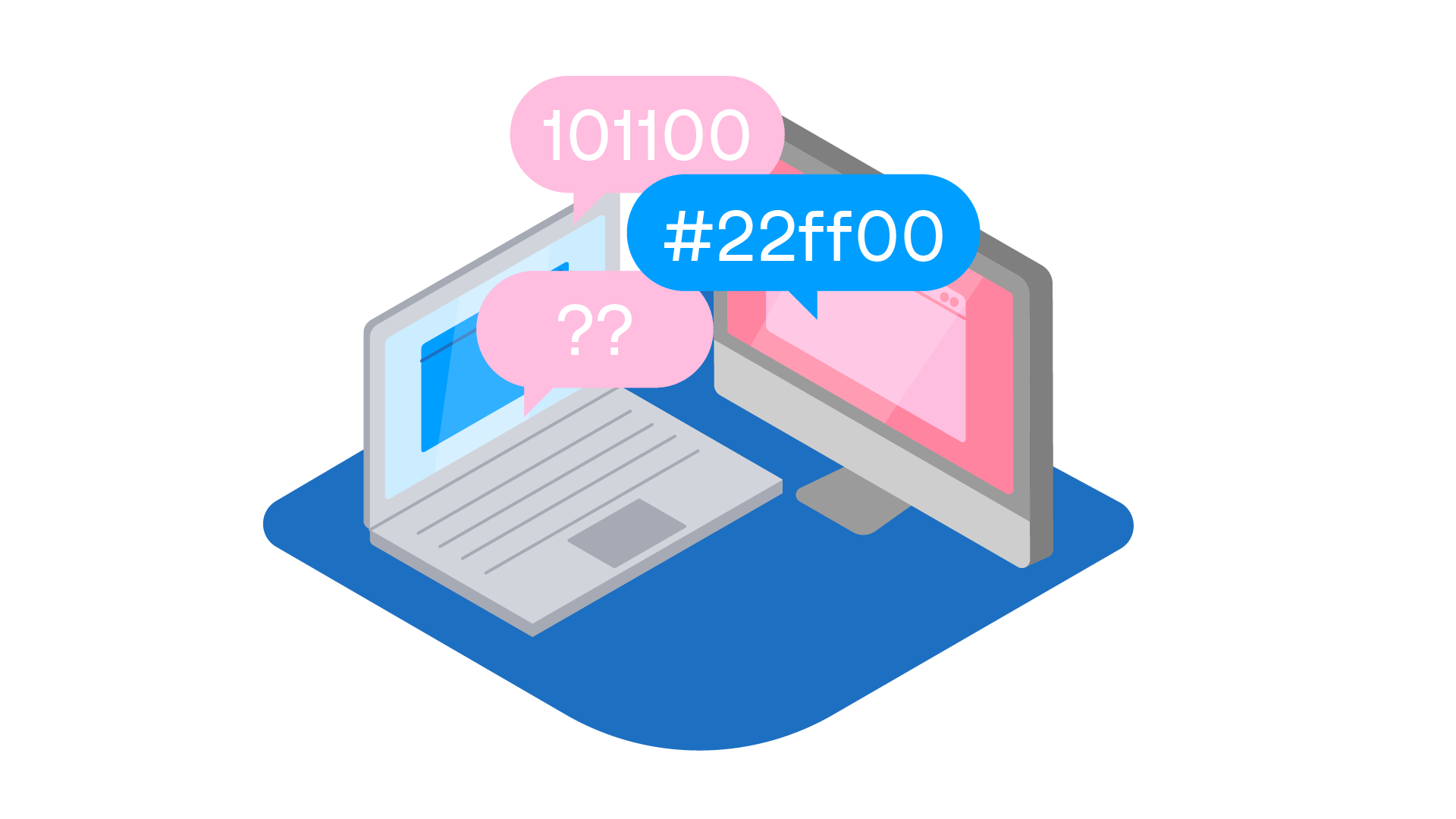
Images and colours
The hexadecimal ("hex") system has 16 units: the numbers 0–9 and the letters A–F, and is commonly used to represent colours. Red, for example, is represented as #FF0000 in hex.
Imaging data is made up of pixels, each represented by a binary number (e.g., black might equal 0, white might equal 1). Representing colour requires more bits per pixel, each extra bit doubles the range of colours available for that pixel, a property known as colour depth. The more colour an image requires, the more bits per pixel are needed, and the larger the resulting file becomes.
What's the specific challenge of data representation in healthcare AI?
The core challenge is that healthcare data needing to be represented in binary code may originally be collected and stored in different formats. For example, the way symptoms, diagnoses, and prescriptions are recorded in electronic health records (EHRs) differs depending on the clinical coding terminology used, Read codes are not the same as SNOMED codes, for instance.
This creates problems when aggregating data: if one hospital records "diabetes" using clinical code 123456 and another uses code 234567, the binary representation of those two codes will differ, even though they represent the same clinical concept. A computer would not automatically recognise both as "diabetes data" for the purposes of training an AI algorithm.
This problem is growing in scale as the number of healthcare data sources expands to include data from wearable devices, at-home sensors, and more.
How is this challenge currently being addressed?
To overcome this issue, different types of data often need to be grouped, transformed, and curated (including handling missing data) before they can be consistently represented in a computable format. This is an intensive process, and there's currently no single agreed-upon methodology, though a wide range of techniques exist, some of which use AI algorithms to help with the data sorting and transformation process.
Some argue it may be more efficient, and less prone to error, to instead focus on standardising and making data inputs more homogenous at the source (i.e., how data is recorded in the first place), rather than dealing with the transformation of heterogeneous data after the fact.
Curious how these principles are being put into practice?
Owkin is building agentic AI and biological reasoning models to better understand biology and advance biological superintelligence.
K Pro
Owkin's agentic AI co-pilot, applying biological reasoning to real biopharma research and decision-making.