A-Z of AI in Healthcare
Digital Twin

Want to see how these kinds of biological models and simulations are being put into practice?
What is a Digital Twin?
A Digital Twin is an exact digital replica of a real-life person, thing, or process that can exchange information with (or "talk to") its real-life counterpart. It's created by collecting and integrating data from multiple sources.
How does a Digital Twin actually work?
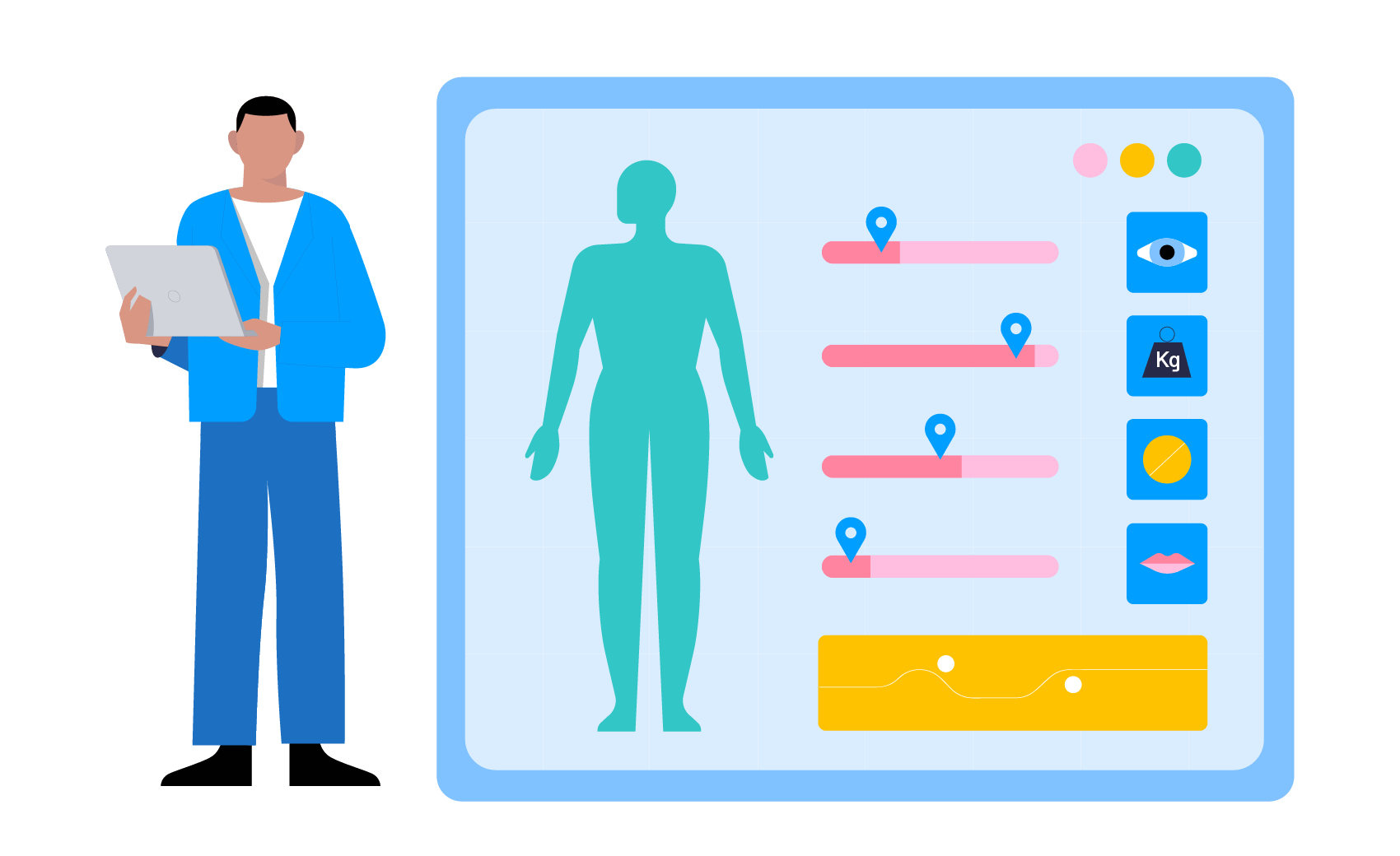
Think of The Sims — the life simulation game where players create and control virtual characters. Now imagine the game could create an exact replica of you, including external attributes (height, weight, eye colour) and internal ones (blood pressure, temperature, prescription medications), with a live connection so that any real-life change — say, losing weight — is automatically reflected in your Sim.
Now imagine wanting to know what would happen if you changed your diet. You create several copies of your Sim, each assigned a different diet: vegetarian, vegan, pescatarian, omnivore. You let the game run for a few days and observe the effects — one Sim loses weight, one is more tired, one is in a better mood. You pick whichever result you want (say, the vegetarian Sim) and make that change in real life.
That's essentially how a digital twin works — except instead of a game, it uses real data and AI to model outcomes for real patients, drugs, organs, hospitals, or entire populations.
What are the core components of a Digital Twin?
Every digital twin is built from three core components:
- The physical asset — the real organ, biological process, person, hospital, healthcare system, or population.
- The digital representation — a simulation or complex computer model of that asset.
- The digital thread — the bi-directional connection between the two, enabling real-time information exchange.
When something changes in the physical twin — a hospital installs a new scanner, or a person starts a new drug — the digital twin updates in near real-time. This lets the effects of the change be simulated, predicted, and monitored, with insights passed back to the physical twin so the outcome can be optimised.
What technology makes Digital Twins possible?
Two technologies work together to enable digital twins: the Internet of Things (IoT) and Artificial Intelligence.
- IoT ensures multiple devices and sensors can accurately measure and track as many features of the physical asset as possible.
- AI analyses and interprets the resulting data for a range of different purposes.
Together, this enables closed-loop optimisation: a change in a variable (e.g., daily calorie intake) is simulated by the digital twin, implemented by the physical twin, and then monitored via sensors tracking real-world effects (e.g., weight change). The digital twin then adjusts its recommendations to further optimise the outcome. This continuous, real-time exchange of information is what distinguishes a digital twin from other types of simulation or modelling.
What are some real-world examples of Digital Twins in healthcare?
Digital Twin Patient
Created using data from regular blood tests recorded in an electronic health record (EHR), wearables tracking exercise, sleep, and heart rhythm, mood-tracking apps, food intake records, and environmental sensors (e.g., air quality). AI then predicts what would happen to the digital twin if something changed — a new diet, for example — and advises the physical patient accordingly, whether that means adopting a positive change or avoiding a negative one.
Digital Twin Hospital
Built from sensors monitoring patient movement (e.g., A&E admissions, radiology queues), equipment and bed usage, staff records, and hospital finances. If a major incident causes a spike in A&E admissions, the digital twin can model the impact on hospital performance and advise administrators — for example, recommending elective surgeries be postponed. It can also simulate scenarios like changes to triage criteria.
Digital Twin Surgery
Combines multiple scans of a patient's body or organs with other clinical information, such as medications that might affect anaesthesia response or blood clotting. Surgeons can use this twin to plan and rehearse a procedure beforehand, plan aftercare, or simulate responses to unexpected complications during surgery itself.
Digital Twin Clinical Trial
Involves generating a synthetic patient cohort — a control group or alternative treatment group — that closely mirrors a real cohort using EHR data. This allows trial teams to simulate protocol changes without experimenting on real patients, and enables n-of-1 trials, where multiple treatment options are tested virtually on a single patient before the optimal plan is applied in real life.
Digital Twin Drug Discovery
Brings together data on a drug's components alongside data about the patients, diseases, or symptoms it's intended to treat. Researchers can simulate the effects of altering the drug's formulation, or model changes intended to reduce side effects, before replicating any change in the physical world — potentially making drug discovery cheaper, safer, and more effective.
Is Digital Twin technology already in use in healthcare?
Not fully — many of these applications remain largely conceptual rather than in widespread practice today. Still, wider adoption of digital twin technology is expected to generate cost and efficiency gains for healthcare systems (for example, by reducing wasted resources) and make healthcare more precise — such as tailoring drug dosage to an individual patient rather than population averages.
Curious how these principles are being put into practice?
Owkin is building agentic AI and biological reasoning models to better understand biology and advance biological superintelligence.
K Pro
Owkin's agentic AI co-pilot, applying biological reasoning to real biopharma research and decision-making.